Saturday, April 13, 2013

#4 Indian Universities Among the World's Best


Bangalore: The effect of positive educational reforms in the country has finally been rewarded, as four Indian universities have made it to the prestigious list of YouthInc Global Business School Rankings 2013.


The survey was a joint venture of Youth Incorporated and Rediff.com, and this report also inculcates inputs from the members of all the prestigious institutions, as well as students to comply the data.  


The survey indicates that, while there has been a major shift in the list, top universities such as Harvard and Stanford managed to stay afloat and retained their top slots.


Nine of the top ten slots in the list are occupied by the U.S. universities, which reflect their domination in education over the rest. The survey also indicated that the educational standard in the Asian continent is getting bigger and a total of 17 Asian Institutes were slotted within the top 100.  And China has the most representations among the Asian countries with 5 institutes slotted in the rankings.

New Kawasaki Ninja 300 – A Closer Look And Pictures [24 Images]


Kawasaki-Ninja-300 (1)


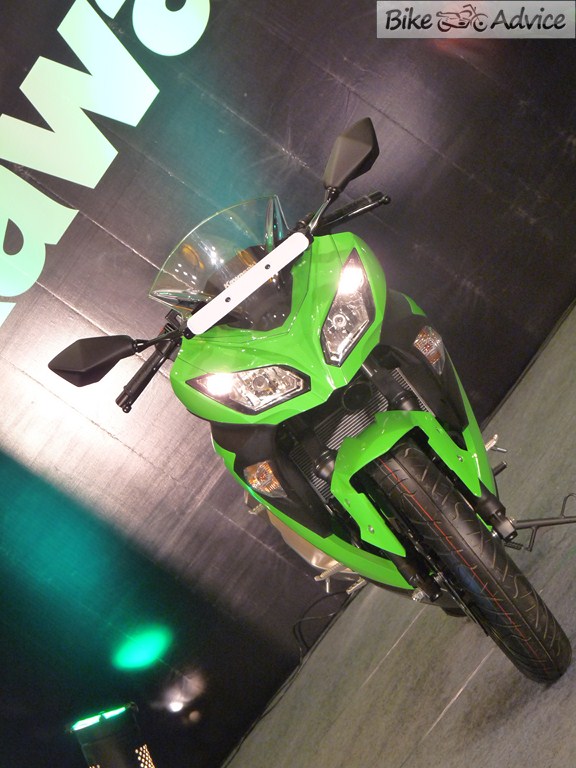
Amidst a lot of fanfare and speculations, Bajaj Auto launched the Kawasaki Ninja 300 today in the Indian market at a glittering function in Pune.
Simply put, it replaces the flagship and older Ninja 250R. Although Kawasaki still produces and sells the Ninja 250R in other markets, for some good reasons, they decided to discontinue the old one and bring in the new Ninja 300. Bajaj ProBiking showrooms, through which Ninja 300 will be sold, have already started accepting bookings all over the country.
Kawasaki-Ninja-300 (24)
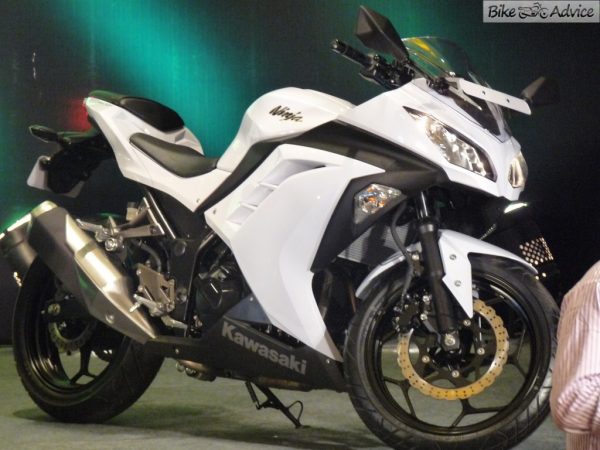
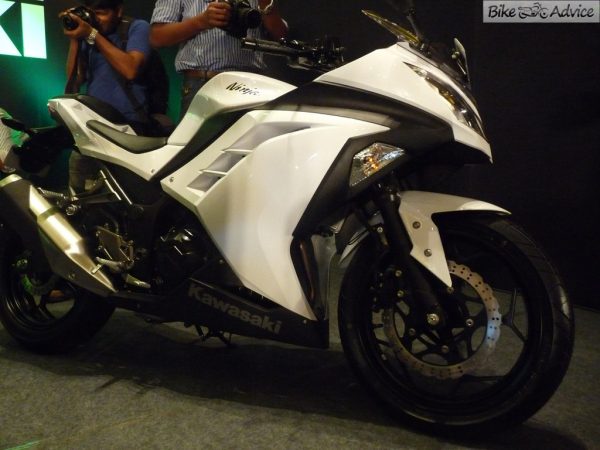
There is a lot of it which has undergone the designer knife treatment. The biggest change is the omission of ‘R’ from the name, Ninja 300 name is complete in itself without any prefix or suffix of ‘R’. Compared to the Ninja 250R, the Ninja 300 is sharper and svelte. But the razor sharp edges and small scoops are quite subtle. It really can be perceived as an “all-new” bike in the market.
Kawasaki-Ninja-300 (21)
Underneath, Ninja 300 gets a 296cc mill which is a Liquid cooled, 4 stroke parallel twin, 8 valve motor. As compared to Ninja 250R’s 249cc engine, Ninja 300 gets a longer stroke of 49mm (from 41.2mm). Bore remains the same at 62 mm. With a larger displacement Ninja 300 produces 39 PS of peak power at 11,000 RPM and a maximum torque of 27 NM at 10000 RPM. This is a neat 6PS and 5Nm greater than Ninja 250R.
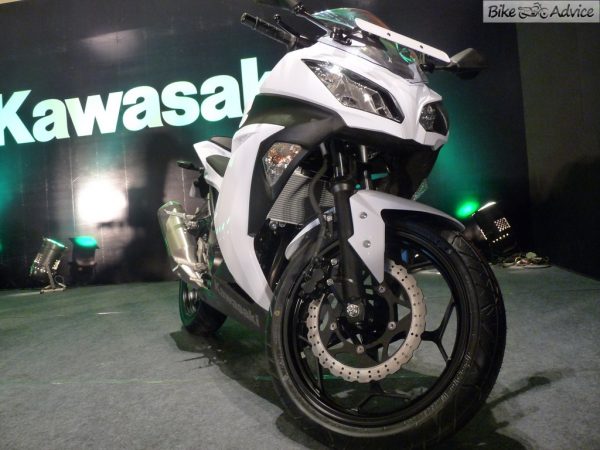
Fuel is force fed into the cylinders via injectors with dual throttle valves. The engine is mated to a 6 speed transmission sending power to the rear wheels. On the inside, you get a diamond steel tube chassis. At the front you get a single 290mm petal disc with dual piston calipers while at the rear there is a 220mm dual piston caliper petal disc. 110/70 and thicker 140/70 17 incher rubbers perform duty at the front and rear respectively.
Kawasaki says that Ninja 300 is inspired from bigger Ninjas and borrow a lot of cues from them. For instance, the fairing design and wheel design from Ninja ZX-14R, Floating windscreen from Ninja ZX-10R etc. The new Ninja 300 comes with better heat management, newly designed seats, wider and raised handlebars all of which combine to give better ergonomics and a claimed more comfortable ride.
Kawasaki also claims that the engine is tuned for better low and mid range power. The frame has also been worked upon to withstand higher power and reduced vibrations. The engine also gets new cylinder head, lighter pistons, new crankcase and oil pan. Ninja 300 also gets rid of Ninja 250R’s biggest qualm. It comes with a contemporary and much better looking semi-digital instrumentation.
However, the biggest disappointment among the biking aficionados of the country will be the omission of ABS. And from the conversations at the event, it doesn’t appear that the company has any plans to bring them anytime soon.
Kawasaki-Ninja-300 (7)
Ninja 300 will be available in the trademark Kawasaki Lime Green and Pearl Stardust White colors which means the black color is also no more. The white color is a real chic-magnet and no wonder you see more white than green here at this page. It is glossy and really rich. Ninja 300 is priced at at Rs 3.5 Lakh ex-showroom Delhi and is available rightaway at dealerships. Dealerships are claiming a wait period of maximum 2 months but are confident of delivering the bike well before that. It appears the company is also better prepared for that this time. At most places price of the bike will be around the Rs 4 lakh mark on road.
After reading this, how many of you are heading to a Bajaj probiking/KTM showroom? And if you are, just drool over these pics before you step out
Kawasaki Ninja 300 Picture Gallery
Kawasaki-Ninja-300 (3) Kawasaki-Ninja-300 (4) Kawasaki-Ninja-300 (5) Kawasaki-Ninja-300 (6) Kawasaki-Ninja-300 (11) Kawasaki-Ninja-300 (10) Kawasaki-Ninja-300 (8) Kawasaki-Ninja-300 (7) Kawasaki-Ninja-300 (9) Kawasaki-Ninja-300 (16) Kawasaki-Ninja-300 (15) Kawasaki-Ninja-300 (14) Kawasaki-Ninja-300 (13) Kawasaki-Ninja-300 (12) Kawasaki-Ninja-300 (17) Kawasaki-Ninja-300 (18) Kawasaki-Ninja-300 (19) Kawasaki-Ninja-300 (21) Kawasaki-Ninja-300 (20) Kawasaki-Ninja-300 (22) Kawasaki-Ninja-300 (23) Kawasaki-Ninja-300 (24) Kawasaki-Ninja-300 (1) Kawasaki-Ninja-300 (2)

Surprise! Two New Pulsars Coming This Year


pulsar 200 ns India release

And if this comes as a big surprise to you, let us tell you that it is as big a surprise for us as well. In an official interview given to Moneycontrol.com, Rajiv Bajaj, MD of Bajaj Auto, has revealed that they are preparing not one but two new Pulsars for launch this year in India.
Now, we all understand that Pulsar 375, based on the upcoming KTM Duke 390′s 375cc engine, is under development. That strikes one out of the list. What Rajiv says is that the other one will be a model smaller than Pulsar 200 NS! Now, this leaves us really bamboozled about the possibility.
One possibility could have been a faired version of Pulsar 200NS but since he says it will be smaller than 200NS, this option goes out of question. We really cannot comprehend what and how smaller will this Pulsar be, as of now, but what we can assure ourselves is that, since it is a Pulsar, it will be exciting!
Rajiv Bajaj also mentions that, gaining from their partnership with Kawasaki, there are finer improvements on all Pulsars that will be sold globally. Bajaj will also keep its focus on Discover brand and segment. After launching Kawasaki Ninja 300 day before yesterday in India, Bajaj’s next shot is KTM Duke 390 which is expected to be launched in a few months from now.
How small the ‘smaller than 200NS’ Pulsar can be? Do share your views in the comments section below as we try to unearth the possibilities!

Dell Launches Partner Advisory Council


Dell has launched a Partner Advisory Council. The announcement was made at the ongoing Partner Summit in Bengaluru.

Over the next year, the council, consisting of 10-15 key Dell partners will provide feedback, share ideas and discuss strategies and programs to augment sales and address enterprise customer needs. The partners will be selected on the basis of their depth of understanding of customer needs.

Richard Lee, Global Vice President & General Manager, Asia Pacific, Global Commercial Channels, Dell, said, “We are very proud of the pace at with the GCC is growing in India. India being a priority market for our business we would like to elevate the manner in which we engage with our partners, which is why we have chosen to launch the Partner Advisory Council.”

Ajay Kaul, Director & General Manager, Global Commercial Channel, Dell India, said, “The Partner Advisory Council has been formed because listening is at the core of the Dell Partner Direct Program. We are sure that the council will succeed in delivering differentiation and become a vital part of our growth plans for India.”

It may be recalled that the company launched the Dell’s Engineer’s Club and the Enterprise Master Tool at the beginning of 2013.  

Friday, April 12, 2013

IBM bets $1 billion on Flash storage

IBM has introduced a new line of solid-state storage systems, Flash System, using technology from its Texas Memory acquisition he hard drive will soon be dead, at least for most uses in the enterprise, IBM is betting. The company is undertaking a major strategic initiative - and $1 billion in research - to make flash the prominent form of storage in most organizations.

IBM has launched a line of Flash-based storage systems, called Flash System, based on technologies IBM acquired when it purchased Texas Memory last year. The company will also open 12 centers around the globe that will help customers prototype flash systems as well as answer their questions about the technology.
A set of FlashSystems could be configured into a single rack capable of storing as much as 1 petabyte of data, capable of producing 22 million IOPS (input/output operations per second). Getting that same level of storage and throughput from a hard drive system would require 315 racks of high performance disks, Mills explained.

Thanks to technology developed by Texas Memory, the eMLC (enterprise multilevel chip) flash chips that these systems use have an average lifetime of 30,000 write/erase cycles, far more than the 1,000 to 3,000 cycles that consumer grade MLCs offer.
FlashSystem joins IBM's other flash and flash and disk hybrid storage systems, including the IBM Storwize V7000, IBM System Storage DS8870 and the IBM XIV Storage System.
With flash systems "You get a lot of storage in a relative small form factor, with very high performance level," said Steve Mills, IBM senior vice president for software and systems, speaking at a New York press conference Thursday.
At the presentation, Mills made the case that it would actually be more cost effective now for organisations to use all solid-state storage rather than hard drives, when all the data-centre costs are tallied.
"There is no question flash is the most economical solution to the business problem when the business problem calls for that class of technology," he said.
IBM estimates that enterprises spend about $20 billion each year buying and maintaining storage systems. "This market is as big as it is because it is an inefficient market. This will profoundly change. Inefficient markets never last forever," Mills said.
Not all systems would benefit from the use of solid-state technologies - only those where performance is a critical factor to operations, Mills stipulated. But performance is a factor across an increasing number of workloads, including transactional processing, analysis and general cloud computing, Mills said.
Increasingly, disk drives are becoming the bottleneck in many latency sensitive systems today, Mills explained. In the past 10 years, great strides have been made in improving the performance of processors, networking and memory, though hard drives have gotten only slightly faster. "It is a mechanical device," Mills said.
Traditionally, enterprise storage systems have relied on hard drives to store data. Because their data is written to a circular platter using an actuator arm that moves back and forth across the disk, hard drives take longer to write and read data than solid-state devices, which can write and read to any location equally as quickly.
To boost hard-drive performance, some organisations stripe, or span, data across multiple disks in order to improve performance, leaving most of each disk empty. This approach speeds system responsiveness because a drive's actuator arm doesn't have to travel across the entire disk to write or read data. But this approach drives up the costs because it requires more hard drives, as well as the associated cost of electricity, space and IT management to keep the disks running.
Solid-state disks have been available for more than a decade, though they have cost more than hard drives and still can't offer the full capacity of hard drives, on a per-disk basis. The prices have been declining, though, as more are used in consumer devices such as smartphones and cameras.

And Mills made the argument that the industry is seeing a tipping point, where flash disks can be just as inexpensive as hard drives.
Right now, generic hard drives cost about $2 per gigabyte, he said. An enterprise hard drive will cost about $4 per gigabyte, and a high-performance hard drive will run about $6 per gigabyte. If an organization stripes its data across more disks for better performance, the cost goes up to about $10 per gigabyte. In some cases, where performance is critical, hard-drive costs can skyrocket to $30 or $50 per gigabyte. A solid state disk from IBM runs about $10 per gigabyte and can be filled to capacity, so they actually are less expensive in many cases, Mills argued.
Also, other economical benefits accrues with using solid-state drives. One is that they consume less electricity. While today most IT managers do not have to worry about how much electricity their systems consume, this may be changing. One IBM customer who spoke at the presentation, Sprint Director of IT Operations Karim Abdullah, noted that his company has mandated that he cut electricity use of his operations by 1.5 percent month over month. Abdullah is using solid-state disks to cut power costs and improve system performance.

CPXcenter